

25 Side Hustles for Teens to Make Money and Build Skills
Let me tell you about the first twenty-dollar bill I ever truly earned. I was 15. It wasn’t an allowance or a birthday gift. I could still smell the faint scent of car wax and soap on it. Holding it felt different. It was heavy with the weight of three long hours spent under the summer sun. This wasn’t just money for snacks or a movie ticket; it was a key. A key to a little bit of freedom, a dose of independence, and a sliver of respect I hadn’t felt before.
But here’s my confession: I was a terrible businessman. My first side hustle was washing neighbors’ cars. I charged a flat $5, thinking it was easy money. My first customer had a small sedan, and it took me 45 minutes. Not bad. But my second customer? He owned a giant, mud-caked SUV that looked like it had just returned from a cross-country rally. It took me three grueling hours to get it clean. I made less than $2 an hour and learned a brutal lesson that day: making money isn’t just about working hard; it’s about working smart.
This guide is built on that lesson. It’s different from the hundreds of boring lists you’ve already scrolled through. This is a playbook. We’re going to skip the fluff and get straight to what works. You will discover why starting your own side hustle is one of the smartest careers moves you can make before you even turn 18. We’ll explore four distinct “Hustle Types” to find the perfect fit for your personality and skills. You’ll get step-by-step launch plans for five high-potential businesses you can start this week with little to no money. And most importantly, I’ll give you the real deal on managing your cash, staying safe, and avoiding the scams and mistakes that trap 90% of beginners.
Part 1: The New Rules: Thinking Like a Teen Entrepreneur, Not Just a Worker
Is a Side Hustle Better Than a Traditional Teen Job?
Here’s what nobody tells you: bagging groceries or flipping burgers is not the best way to prepare for the future. It’s the old way. The common advice is that any job teaches responsibility.1 And sure, a traditional part-time job teaches you how to show up on time, take orders, and maybe handle an upset customer. These are good skills. But they are the skills of an employee.
A side hustle teaches you to be the CEO.
When you start your own small venture, you’re forced to learn a completely different, and far more valuable, set of skills. You’re not just learning one role; you’re learning them all.
- Financial Literacy: You learn budgeting, how to calculate profit, and how to reinvest in your own growth firsthand.
- Problem-Solving: When a client is unhappy or supplies run late, there’s no manager to call. You have to fix it. This builds resilience and critical thinking.
- Marketing and Sales: You have to convince someone that your service is worth their money. This is one of the most valuable skills in any career.
- Creativity and Initiative: You get to decide what to offer, how to improve it, and where to take your business next. You learn to see problems as opportunities.
The other massive advantage is flexibility. A rigid 20-hour-a-week retail schedule doesn’t care about your final exams or the big soccer tournament next weekend. Research shows that working too many hours in a structured job during high school can lead to lower grades, less sleep, and serious burnout. A side hustle adapts to your life. You can scale up during the summer and pull back during finals week, protecting your grades and your mental health. The choice isn’t just about work versus no work. It’s about choosing the path that gives you the most valuable skills and the most control over your life.

How Do You Find an Idea That Actually Makes Money?
Let’s bust two myths right now. Myth #1: “You need a brilliant, original idea.” Myth #2: “You have to turn your passion into a business.” Both are mostly wrong, and they’re what keep most teens stuck.
The “passion trap” is especially dangerous. We’re surrounded by messages telling us to monetize our hobbies. If you love painting, you should sell your art on Etsy, right? Maybe. But thousands of passionate artists open Etsy shops every year and fail miserably because they never stopped to ask if people wanted to buy what they were making. They focused on what they loved to create, not what the market was willing to pay for.
Successful side hustle isn’t born from passion alone. They are born from applying a skill to a problem.
Forget trying to invent the next Snapchat. Instead, use this simple three-step framework to find a goldmine of ideas right in front of you.
- Skill Inventory: What are you already good at? Be honest. Don’t just list school subjects. Are you great at organizing your room? Is you patient with older relatives? Are you the friend everyone asks for help with their gaming setup? Can you make a killer TikTok video? Write it all down.
- Problem Spotting: For one week, become a professional problem-spotter. Listen to what people around you complain about. Your parents are too busy to walk the dog. Your neighbor’s car is always filthy. Your friend’s grandparents are confused by their new iPad. These complaints are business ideas in disguise.
- Find the Intersection: Look at your two lists. Where does one of your skills solve one of the problems you spotted?
- Skill: Good at explaining math. Problem: Younger kids in the neighborhood are struggling with homework. Intersection: Tutoring service.
- Skill: You love dogs and are reliable. Problem: Neighbors work long hours. Intersection: Dog walking.
- Skill: You know your way around Canva. Problem: The local pizza shop has a terrible Instagram page. Intersection: Social media manager.
That intersection is where you start. It’s not about finding a magical idea nobody has thought of. It’s about finding a common, annoying problem that you can solve better, more reliably, or with more care than anyone else.

Part 2: The Side Hustle Deep Dives: Your Step-by-Step Playbooks
Theory is great, but action is what pays the bills. A recent survey found that 69% of teens have a business idea but are unsure how to start. This section is designed to fix that. Here are the exact, step-by-step playbooks for five high-potential hustles you can launch this week.
The Local Pro Playbook: How Do I Start a Service Business in My Neighborhood?
These are businesses built on trust, reliability, and doing great work for the people who live around you. Startup costs are almost zero, and word-of-mouth is your best marketing tool.
Deep Dive 1: The Dog Walking and Pet Sitting Empire
- Why It Works: The demand is huge and constant. People treat their pets like family and will gladly pay for trustworthy care, especially if you’re a familiar face from the neighborhood. It’s a low-cost business with the potential for recurring revenue, the holy grail of any service business.
- Step-by-Step Launch Plan:
- Market Research (1 Hour): Don’t guess your price. Go on sites like Rover or Wag and search for services in your zip code. See what others charge for a 30-minute walk or a drop-in visit. The national average is around $20 to $30 per 30-minute walk, but it varies by location. Write down the top three prices you see.
- Define Your Service and Price (1 Hour): Keep it simple. Start by offering only two things: 30-minute dog walks and 30-minute “drop-in” visits (for feeding, potty breaks, or playing with cats). Price yourself slightly below the average you found, but not so low that you seem cheap. If the average is $22, charge $18 or $20. This makes you a competitive but professional choice.
- Get Legit (With a Parent): This is a business, not just a favor. Talk to your parents about liability. Basic pet-sitting insurance is surprisingly affordable and is a massive signal to clients that you are a professional. It protects you if an animal gets hurt in your care and shows you’re taking this seriously.
- The “First Five Clients” Plan (1 Weekend): Forget printing 100 flyers that will end up in the trash. Your first clients will come from your “trusted circle.” Make a list of 5-10 neighbors, family friends, or relatives who have pets. Approach them in person or with a polite text. Say something like: “Hi [Name], I’m starting a local pet-sitting and dog-walking business to save up for. I’m offering a special introductory rate for my first few clients. Would you be interested in a discounted walk for [Pet’s Name] next week?” Your only goal is to get five “yeses” and start building a reputation.

Case Study 1: How Maya Made $850 in Her First Month Pet Sitting
Maya, 16, wanted to earn enough money to buy tickets to see her favorite artist, which were going to cost around $200. She loved animals, so she decided to try pet sitting.
- Action: Instead of just posting on social media, she followed the “First Five Clients” plan. She talked to four neighbors on her street and her aunt. Three neighbors hired her for regular, twice-a-week dog walks, and her aunt booked her to watch her two cats for a full week while she was on vacation.
- The Mistake: In her second week, she got excited by a new request and accidentally booked two dog walks on opposite sides of the neighborhood at the same time. She had to sprint between houses and was five minutes late for the second walk. The client was nice about it, but Maya learned a huge lesson: use a calendar and leave buffer time between appointments.
- The Outcome: Between the three regular dog walking clients ($20/walk, twice a week) and the week-long cat sitting gig ($35/day), Maya earned $850 in her first month. She created a simple spreadsheet to track her income and her only expenses: $35 for extra poop bags and a few new cat toys. Her net profit was $815 more than enough for her concert tickets and a solid start to her savings.
Deep Dive 2: The Mobile Car Detailing Business
- Why It Works: The profit margins are fantastic. Most people dislike cleaning their cars and will happily pay for the convenience. You can charge $50-$150 or more for a few hours of work, and you can start with supplies you probably already have in your garage.22
- Step-by-Step Launch Plan:
- The “Dad’s Garage” Audit (30 Minutes): Before you buy anything, take inventory. You likely have access to buckets, sponges, a hose, and a vacuum. The only things you might need to buy are high-quality microfiber towels, a good car soap (don’t use dish soap!), and an interior detailer spray. You can get started for under $50.22
- Create Service Tiers (30 Minutes): Don’t just offer a “car wash.” Professionals sell packages. This makes your service seem more valuable and helps customers choose what they need.
- Bronze Package ($40): A thorough exterior hand wash and dry, clean wheels and tires, and tire shine.
- Silver Package ($75): Everything in Bronze, plus a full interior vacuum (floors, seats, trunk), wipe-down of all hard surfaces (dashboard, console), and cleaning interior windows.
- Gold Package ($120): Everything in Silver, plus a hand-applied wax to the exterior and a deep cleaning of floor mats.
- Build Your Portfolio (1 Weekend): This is the most critical step. Ask your parents or a trusted neighbor if you can detail their car for free. Your only “payment” is the right to take detailed before-and-after photos. Capture the dirty floor mats, the dusty dashboard, and the bug-splattered bumper. Then, take the exact same shots after you’re done. This visual proof is your entire marketing strategy.
- Launch Your Business: Post your best before-and-after photos on a local community Facebook group or the Nextdoor app. Don’t just say “I wash cars.” Use a powerful headline like: “Your car is dirtier than you think. I can fix that. Mobile detailing starts at $40. Swipe to see the difference.” The photos will do the selling for you. Adults are hesitant to trust a teenager with an expensive asset like a car. A flyer is just a claim, but a dramatic before-and-after photo is undeniable proof of your skill.
The Creator Playbook: How Can I Make Money Online with My Talents?
If you’re creative, artistic, or have a knack for being on camera, the internet offers a global audience. But it also comes with fierce competition. Success here is about finding a specific niche and being professional from day one.
Deep Dive 3: Selling Your Art and Crafts on Etsy
- Why It Works: Etsy is a massive marketplace with millions of buyers who are specifically looking for handmade, unique, and vintage items. It gives you instant access to an audience you couldn’t build on your own.
- The Reality Check: Here’s the hard truth: most new Etsy shops fail. It’s not enough to just make pretty things. Success on Etsy is a business skill. It requires understanding what people are searching for (SEO), taking amazing photos, and picking a niche that isn’t completely oversaturated.
- Step-by-Step Launch Plan (for teens):
- The Legal Setup (With a Parent): This is non-negotiable and the most important rule. If you are under 18, a parent or legal guardian must open the Etsy account in their name, using their ID and financial information. You are then permitted to operate the shop under their direct supervision. This is Etsy’s official policy to comply with legal contract laws.
- Niche Down or Drown: This is the most common mistake. Don’t try to sell “cute stickers.” That market is impossibly crowded. Instead, sell “vinyl stickers for fantasy book lovers” or “holographic decals for PC gamers.” The more specific your niche, the easier it is for the right customers to find you in Etsy’s search results.
- Price for Actual Profit: Don’t just guess the price. Use this simple formula to start:
(Cost of Supplies + Value of Your Time) * 2 =Wholesale Price
Wholesale Price * times 2 = Retail Price
Remember to account for Etsy’s fees, which include a $0.20 listing fee per item and a 6.5% transaction fee on the total sale price.25 If your materials cost $1, you spend 30 minutes making it (value your time at, say, $15/hour, so $7.50), your retail price should be around $34.
- The “10 Perfect Listings” Launch: Don’t open your shop with just one item. aim to launch at least 10 distinct products. Take bright, clear photos in natural light from multiple angles. Write detailed descriptions using keywords you think your ideal customer would type into the search bar. For example, instead of “Blue Earrings,” use “Lightweight Polymer Clay Earrings, Royal Blue Teardrop Dangle, Handmade Gift for Her.”

Case Study 2: My First Year on Etsy A Story of 3 Failed Shops and 1 Success
This isn’t just a success story; it’s a story about the reality of entrepreneurship, inspired by the honest struggles shared by real sellers.
- Shop 1 (The Trend Chaser): I started a print-on-demand t-shirt shop with funny slogans I saw on TikTok. Result: Failure. The competition was insane, the profit margin was less than $2 per shirt, and I made zero sales. I closed it after two months.
- Shop 2 (The Digital Dream): I heard digital products were pure profit, so I created a set of generic digital planners. Result: Failure. The idea was good, but the market was completely saturated. I didn’t know how to make my listings stand out. I made three sales (thanks, Mom and Aunt) and closed it after four months.
- Shop 3 (The Niche I Knew): I was frustrated but not defeated. I took a step back and thought about what I loved. I was a huge fan of “cottagecore” and “dark academia” aesthetics. So, I started making small batches of handmade polymer clay earrings inspired by those themes.
- What Changed: I stopped chasing trends and focused on a specific audience I was a part of. I watched a dozen YouTube videos on “Etsy SEO” and rewrote all my titles and descriptions. I spent $50 on a better lighting setup for my product photos.
- The Outcome: It was slow at first. But then I got my first sale from a stranger. Then another. By the end of my first year, I had made over $2,200 in profit. The biggest lesson? Failure is just data. Each failed shop taught me what not to do, which was more valuable than any quick success.
Deep Dive 4: Starting a YouTube Channel (That Actually Pays)
- Why It Works: YouTube has massive earning potential and allows you to build a community around literally any topic you’re passionate about, from gaming to baking to history. But be warned: this is a marathon, not a sprint.
- Step-by-Step Launch Plan:
- The Legal Setup (With a Parent): To earn money from ads on YouTube, you need a Google AdSense account. If you are under 18, this account must be created and managed by a parent or legal guardian. They will then link their approved AdSense account to your YouTube channel.
- Find Your Hyper-Specific Niche: “Gaming channel” is not a niche. “A channel that reviews indie horror games under $10” is a niche. “Baking channel” is not a niche. “A channel that recreates desserts from famous movies” is a niche. Specificity is your only advantage as a new creator.
- Gear Up (for cheap): You do not need a $2,000 camera. Your smartphone is more than capable of shooting great video. The two things that matter more are audio and lighting. A simple $20 lavalier microphone that clips to your shirt will make you sound 100 times more professional than the built-in phone mic. And filming in front of a window with natural light is free. For editing, a free app like CapCut is all you need to start.
- Understand the Path to Monetization: Know the milestones. To apply for the YouTube Partner Program (YPP) and start earning money from ads, you need to hit two targets: 1,000 subscribers and 4,000 hours of public watch time within a 12-month period.
- Your First 10 Videos: Plan your first 10 video ideas before you even record one. Focus on creating content that answers a question or solves a problem. Use simple, searchable titles like “How to Build a Simple Starter House in Minecraft” instead of “My First Minecraft Let’s Play!” Posting consistently once a week is a perfect starting goal.
What most beginner guides won’t tell you is that chasing ad revenue is a trap for small channels. The income is tiny; a channel with 1,000 subscribers might only make $30-$300 per month from ads. That’s not life-changing money. The real strategy is to ignore ad revenue for the first year. Focus 100% on creating valuable, engaging content that builds a loyal community that trusts you. Once you have that trust, even a small audience can generate significant income through affiliate marketing (recommending products you use and getting a commission) or sponsorships, which pay far more than ads.
The Freelancer Playbook: How to Sell Your Digital Skills Online
Many small businesses are run by people who are experts at their craft making coffee, fixing cars, arranging flowers but are clueless when it comes to the digital world. This is your opportunity. As a teen, you are a digital native, and your skills are in high demand.
Deep Dive 5: The Teen Social Media Manager
- Why It Works: Thousands of local businesses have terrible social media or none. They know they should be posting on Instagram or TikTok, but they don’t have the time or the know-how. You do. You can offer a valuable service they desperately need at a price they can afford.
- Step-by-Step Launch Plan:
- Build a “Proof Portfolio” (1 Week): You don’t have experience, so you need to create it. Pick a local business you genuinely like a coffee shop, a bookstore, a boutique. Go into a free tool like Canva and design 3-5 sample Instagram posts for them. Create engaging captions and find relevant hashtags. Put this into a simple PDF or Google Slides presentation. This is now your portfolio. It shows, not just tells, what you can do.
- Find Your First Client (The Hyper-Local Method): Forget freelance websites for now. The competition is too high. Walk into 5-10 local businesses in your town. Ask to speak to the owner or manager. Be confident and polite. Say: “Hi, my name is. I’m a huge fan of your shop. I’m a local high school student looking to gain experience in social media marketing, and I put together a few ideas for your Instagram page. Would you have two minutes for me to show you?”
- Make an Irresistible Offer: After you show them your sample posts, offer a low-risk trial. Say, “I’d love the chance to prove what I can do. For the first month, I can create and post for you three times a week for just $100.” This is an easy “yes” for a small business owner. Your goal isn’t to get rich on day one; it’s to get a client and a testimonial.
- Set Your Rates for Future Clients: Once you have one successful client, you have leverage. You can start charging more. Beginner teen social media managers can realistically charge $15-$30 per hour for their work. A package of 12 posts per month (3 per week) could be priced at $200-$300.

Freelance Platform Face-Off: Fiverr vs. Upwork for Teens
When you’re ready to expand online, you’ll run into Fiverr and Upwork. They seem similar, but they are fundamentally different, and choosing the right one is critical.
| Feature | Fiverr | Upwork | The Verdict for Teens |
| Age Requirement | 13+ (with parent/guardian account) | Strictly 18+ | Fiverr is the only option. Upwork’s terms of service legally prohibit users under 18. |
| How You Get Work | Clients browse your “Gigs” and buy your pre-packaged service. | You actively search for jobs and submit proposals, competing against other freelancers. | Fiverr is more beginner friendly. You set up your shop once and let buyers come to you, which is less intimidating than writing proposals. |
| Project Type | Best for small, well-defined, one-off tasks (e.g., “I will design one logo,” “I will edit a 30-second video”). | Favors larger, more complex, and long-term projects (e.g., “Ongoing blog writer needed,” “Re-design our entire website”). | Fiverr is better for starting out. It allows you to complete small projects quickly, build a portfolio of positive reviews, and gain confidence. |
| Fee Structure | A flat 20% commission on all earnings, regardless of the amount. | A sliding scale: 20% on the first $500 with a client, then 10% up to $10,000, and 5% after that. | A tie, but irrelevant. Since Upwork is not an option for teens, Fiverr’s 20% fee is the cost of doing business on the platform. |
| Overall | The clear winner for teens. Its age policy, “productized” service model, and focus on small gigs make it the ideal platform for a young freelancer to get started, build a portfolio, and earn their first online income legally and safely. | A powerful platform for experienced adult freelancers seeking long-term, high-value clients, but inaccessible and unsuitable for most teenagers. | Go with Fiverr. It’s built for the kind of quick, skill-based tasks that are perfect for a teen’s first foray into online freelancing. |

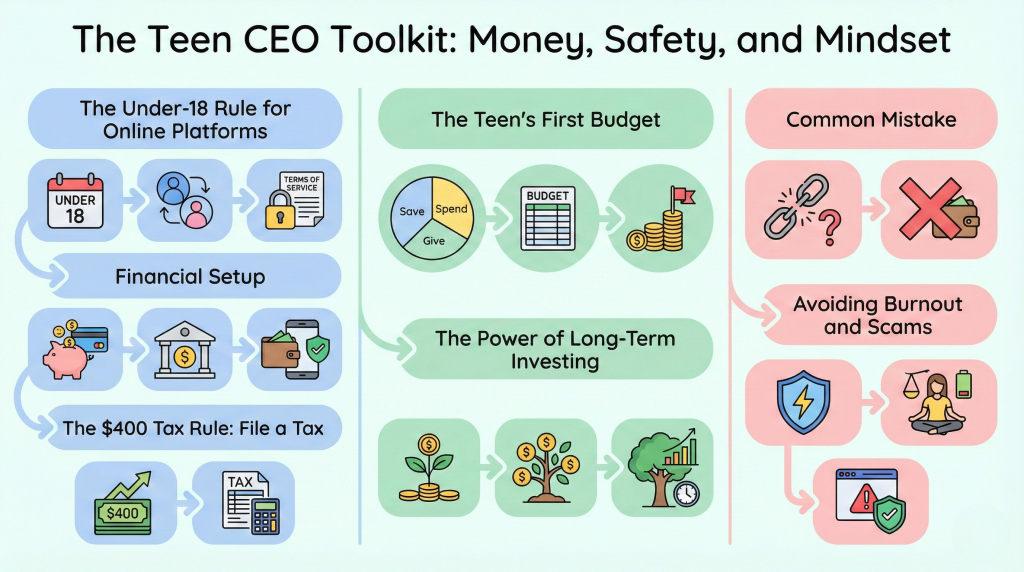
Part 3: The Teen CEO Toolkit: Money, Safety, and Mindset
Making money is only half the battle. Learning how to manage it, operate safely, and stay motivated is what turns a small side hustle into a life-changing experience.
“Is This Even Legal?” A Teen’s Guide to the Rules of Making Money
Let’s clear this up, because it’s important for both you and your parents. The short answer is yes, it’s completely legal for you to earn your own money. But there are a few rules you need to follow, and they all revolve around one central theme: parental partnership.
- The Under-18 Rule for Online Platforms: Almost every online service that involves money Etsy, eBay, Fiverr, PayPal, Google AdSense requires the account owner to be at least 18 years old. This is because a contract with a minor is not legally binding. The only way to use these platforms is for a parent or legal guardian to open the account in their name and give you permission to use it under their supervision. This isn’t a loophole; it’s the official, required way to do it.
- Getting Paid: You’ll need a bank account. The easiest way to handle this is for a parent to open a joint checking account with you or a specific custodial account for your business earnings. This keeps your hustle money separate from your personal allowance and makes tracking income easy. Tools like Greenlight can also be a great way to manage your earnings with parental oversight.
- The $400 Tax Rule (Don’t Panic!): This sounds scary, but it’s simple. In the U.S., if you earn more than $400 in profit (income minus expenses) from self-employment in a year, you are legally required to file a tax return. This is a great learning opportunity. Sit down with your parents, use a service like TurboTax, and walk through the process. Tracking your income and expenses from day one makes this incredibly easy.

You’ve Made Money! Now What? A Teen’s First Budget
Earning your first paycheck is the best financial literacy class you’ll ever take. But it’s what you do after you get paid that determines your financial future. A shocking 74% of teens don’t feel confident about their financial education, and many adults are drowning in debt because they never learned these basic skills.51 You can break that cycle right now.
Forget complicated spreadsheets. Use the simple 50/30/20 Budget, adapted for a teen’s life.
- 50% for Your “Wants”: This is your guilt-free spending money. Use it for food with friends, video games, clothes, or whatever you want right now. Enjoy the rewards of your hard work.
- 30% for Short-Term “Savings”: This is for bigger goals you want to hit within the next year. Think of a new phone, a gaming console, your first car, or a big trip. Having a specific goal makes saving much easier.
- 20% for Long-Term “Investing”: This is the most powerful category. This is your “Future You” fund. By putting even, a small amount away now, you give it decades to grow through the magic of compound interest. Talk to your parents about opening a Custodial Roth IRA. It’s a type of investment account that can grow tax-free for retirement, and it’s one of the most powerful wealth-building tools you can start using as a teen.
A budget isn’t a restriction; it’s a plan for your freedom. It ensures you can enjoy your money today while also building the future you want.
The Dark Side: Common Mistakes, Scams, and How to Avoid Burnout
I wish I could tell you it will all be easy, but it won’t. You will make mistakes. But if you know what to look for, you can avoid the worst ones.
- Mistake #1: Underpricing Your Work. I did it with my first car wash gig, and you’ll be tempted to do it too. You’ll be so excited to get a “yes” that you’ll agree to a price that doesn’t respect your time. Always calculate your hourly rate. If a project takes you 4 hours and you only make $20, you’ve worked for less than minimum wage. Value your time.
- Mistake #2: Choosing a “Fake” Hustle. Some things that are marketed as side hustles are just timewasters. The biggest culprit? Online surveys. They promise easy money, but the reality is very different.
- Scam Alert: The “Get Rich Quick” Guru. Be extremely wary of anyone on TikTok or Instagram flashing rented Lamborghinis and selling a “secret” drop-shipping or crypto course for $997. They make their money by selling you the dream, not by doing the business. Real success takes time and effort; there are no shortcuts.
- The Burnout Zone: Your side hustle should fit around your life, not consume it. School, health, and family come first. Multiple studies have shown that working more than 20 hours a week during the school year can seriously harm your grades and mental health. If you’re staying up until 2 a.m. packing orders or skipping homework to answer client emails, it’s time to scale back. Your business should serve you, not the other way around.

Are Online Surveys for Money Legit? A Reality Check
This is one of the most common questions, so let’s settle it once and for all. Yes, they are “legit” in that some will pay you. But they are terrible side hustle. Here’s a realistic breakdown of what you can expect to earn.
| Platform | Minimum Age | Payout Method | Realistic Hourly Rate (after disqualifications) |
| Swagbucks | 13+ | PayPal, Gift Cards | ~$1-$2 per hour |
| Survey Junkie | 12+ (in some sources) | PayPal, Gift Cards | ~$1-$3 per hour |
| Branded Surveys | 16+ (or 13+ in some sources) | PayPal, Gift Cards | ~$1-$3 per hour |
| InboxDollars | 12+ | Check, Gift Cards | <$1 per hour (often frustrating) |
The Verdict: Online surveys are not a side hustle. They are a micro-earning activity. You will spend a lot of time getting disqualified halfway through surveys. Use them to earn a few dollars while you’re watching TV if you want, but do not mistake this for a real business that can build skills or significant income. Your time is better spent on almost any other activity on this list.
Frequently Asked Questions
- What’s the best side hustle for a 14-year-old with no money?
A local service business is your best bet. Dog walking, yard work, or offering tech help to seniors requires zero startup costs. You are selling your time and skills, not a product. Start with people you know (neighbors, family) to build trust.
- How do I convince my parents to let me start a business?
Approach them with a plan, not just an idea. Show them this article. Explain the legal requirements and how you plan to follow them (e.g., “I know you need to open the Etsy account in your name”). Create a simple budget for any startup costs. When you show them, you’ve thought it through and are taking it seriously, they are much more likely to support you.
- Can I really make $1,000 a month as a teen?
Yes, it is possible, but it is not typical for a beginner. It requires consistency, professionalism, and a good business model. A pet sitter with several regular clients or a mobile detailer who books a few “Gold Package” jobs every weekend could easily clear this amount. But your goal for the first few months should be much smaller: get your first client and make your first $100.
- What happens if a client doesn’t pay me?
For service businesses, always agree on the price before you start the work. For bigger jobs, you can ask for 50% upfront. If you’re using a platform like Fiverr, they hold the client’s money in escrow, so you are protected if you deliver the work as promised.
- Do I need a business license as a teen?
For most small, informal side hustles like dog walking or lawn mowing in your neighborhood, you typically do not need a formal business license. However, this varies by city and state. It’s a good topic to research with your parents as your business grows.
- What’s the easiest side hustle to start tomorrow?
Selling things, you no longer need. Go through your room and find old clothes, video games, or electronics. With a parent’s help, list them on Facebook Marketplace or eBay. It’s a quick way to make some cash and learn the basics of online selling.
Conclusion: Your Journey Starts Now
Remember that first $20 bill? The real value wasn’t the number printed on it. It was the proof. Proof that you could create value out of thin air. Proof that your time and skill were worth something. Proof that you could be more than just a kid, you could be a creator, a problem-solver, an entrepreneur.
That’s the true power of a side hustle. It’s not just about the money you’ll make this summer. It’s about the skills you’ll build, the confidence you’ll gain, and the person you’ll become in the process.5 You’ll learn more about business, finance, and yourself from one unhappy customer than you will from an entire semester in a classroom.
So don’t get stuck in “analysis paralysis.” You don’t need a perfect idea or a 50-page business plan. You just need to start.
Here is your challenge: In the next 24 hours, take one small, tangible step. Don’t “start a business.” Instead, do the “Dad’s Garage Audit” for a detailing business. Or go on Rover and research the dog walking rates in your zip code. Or watch one 10-minute YouTube video on Etsy SEO. Pick one tiny action that moves you from thinking to doing.
What’s the first side hustle you’re going to explore, and what’s the biggest question you still have? Share it in the comments below let’s build this together.

Alex Rodriguez specializes in simplifying investing and financial planning so beginners can feel confident taking their first steps. With a background in finance and a passion for financial literacy, he breaks down topics like index funds, retirement accounts, and long-term wealth-building into plain language and realistic action plans. At Dollar Pioneer, Alex creates guides and tools that help readers understand their options, compare strategies, and build investment habits that support their long-term goals, not just quick wins.


