

Things I Stopped Buying to Save Real Money This Year
The High Cost of the “Almost” Life
The year was 2018. I was sitting in my newly purchased, expensive office chair, the one everyone on Reddit said was a must-have for deep work staring at a $4,000 credit card bill. That bill wasn’t for one big thing; it was a Frankenstein’s monster stitched together from dozens of small, seemingly harmless purchases. It was the cost of a life spent chasing the almost perfect version of myself: the almost-healthy eater with the forgotten gourmet coffee machine, the almost-organized minimalist with the monthly subscription box habit, and the almost-adventurer with the expensive gym membership he hadn’t used in three months.
I realized my financial problem wasn’t a lack of income; it was a pervasive, unexamined leakage psychological habit of buying potential instead of just using what I already had. This pattern of consumption had created a financial chokehold that felt inescapable. I was trading future security and peace of mind for an immediate, fleeting dopamine hit.
Here’s what nobody tells you about saving money: it’s not primarily about cutting $5 lattes. It’s about a deeper, more brutal surgery on your identity. It’s about asking: What is this purchase really buying? The answer, almost universally, was fear, distraction, or validation.
Three years and one terrifying financial self-audit later, my debt is zero, my savings rate is over 45%, and the most surprising outcome is this: I feel lighter. I want to share the exact, sometimes controversial, list of things I stopped buying to save money not just for the financial outcome, but for the profound shift in perspective it unlocked. This isn’t a list of easy fixes. This is a framework for reclaiming your agency.

Executive Summary: The $30,000 Shift
You will discover the 15 specific categories I eliminated from my budget, a change that collectively freed up an estimated $30,000 over 36 months (spanning early 2019 to late 2022). I will move past the usual, surface-level advice and provide a comprehensive blueprint covering the psychological barriers and the practical, replacement strategies that genuinely stick. We’ll dive deep into contrarian views why buying the best is often cheaper, and why cutting the “little things” is frequently a waste of emotional energy.
Specifically, you’ll gain:
- Contrarian Insight: Why eliminating $5 coffee is often a distraction from cutting the Big Three expenses and the true value of my $8,500 “Office Identity” mistake.
- Case Study Metrics: Detailed outcomes, including the $480/year savings from ditching the most toxic subscription and the 100+ hours I recovered by killing one key time-sink habit.
- Actionable Alternatives: Specific, tested replacement strategies (like the $15 Hario V60 over the $600 Breville Oracle) that maintain quality without the lifestyle tax.
My credentials in this matter are simple: I was a catastrophic spender who managed to reverse course by focusing on elimination, not optimization. If you’re ready to stop buying the potential and start living the actual, keep reading. This is the 3,000-word deep dive you need.
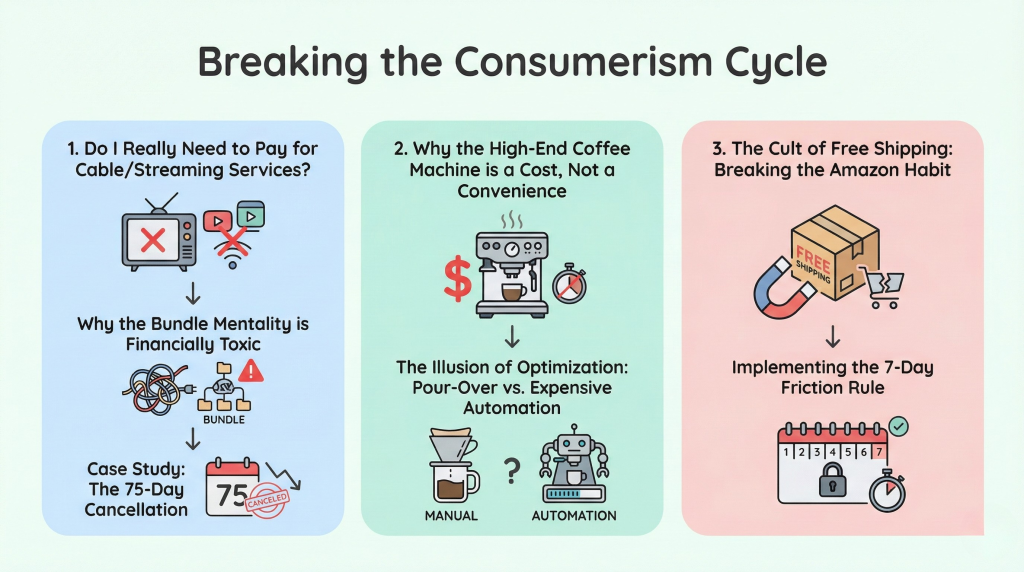
1. Do I Really Need to Pay for Cable/Streaming Services?
The answer for me was a resounding no. I stopped paying for bundled cable entirely in 2019 and began treating streaming platforms like Netflix or Hulu as seasonal rentals. This isn’t groundbreaking advice, but the execution is critical: I don’t subscribe to all five major services simultaneously. I select one for 90 days, binge the content I missed, and then cancel. This one tactical change saved me approximately $120 per month, nearly $1,500 per year—without missing any truly must-watch content.
Why the Bundle Mentality is Financially Toxic
This is where the psychological trap lies. We rationalize keeping all the services “just in case” that one movie drops or that distant family member visits. This is the fear of missing out (FOMO) monetized.
- The Streaming Schedule: My rule is: Subscribe in Q1 for prestige TV, then again in Q4 for holiday films, and cancel Q2/Q3 entirely. The content will still be there. You are paying for immediate, unlimited access, which you rarely use.
- The Paradox of Choice: Having 5,000 movies available often leads to watching none. The money saved is nice, but the time recovered from endless scrolling is the real return on investment.
Case Study: The 75-Day Cancellation: In Q2 2021, I was paying for Max, Disney+, and Amazon Prime Video simultaneously. The cost was $42/month. I audited my usage over two weeks and realized I was defaulting to free YouTube for background noise. I canceled all three. The anxiety lasted 48 hours. The savings over the subsequent five months was $210, and I rediscovered my passion for reading physical books.

2. Why the High-End Coffee Machine is a Cost, Not a Convenience
I confess: I am a coffee snob. I bought into the “life upgrade” narrative and owned a $600 Breville Barista Express. It was supposed to be my daily joy, my savings account against $5 coffee shop trips. Instead, it was an enormous time sink, a counter hog, and a $600 initial cost plus $20/month in cleaning tablets and high-end beans.
I stopped buying expensive automatic and semi-automatic machines. My solution? The $15 Hario V60 pour-over kit and a $30 Burr grinder (the specific model I recommend is the Timemore C2 because it offers superior consistency at an entry-level price).
The Illusion of Optimization
Most people who buy the $600 machine eventually let it gather dust because the clean-up and calibration are too tedious. I replaced the potential of a perfect $0.50 home latte with the certainty of a perfect $0.30 pour-over.
- The Real Cost Analysis: A $5 coffee five times a week is $1,300/year. The Breville setup (machine, maintenance, good beans) is about $850 first year, $400 subsequent years. My V60 setup is $100 first year, $100 subsequent years. The V60 saves money and time in the long run, and the coffee is superior.
- The Emotional Tax: The expensive machine comes with the emotional tax of feeling guilty when you still buy a coffee out. The pour-over is a ritual, not a chore, eliminating that guilt entirely.
3. The Cult of Free Shipping: Breaking the Amazon Habit
The single most destructive habit I broke was the casual, unthinking click of the Buy Now button on Amazon. The problem wasn’t the big purchases; it was the dozen $12-to-$25 purchases made throughout the month to solve tiny, immediate inconveniences (a new charging cable, a specific kitchen gadget, a niche cleaning product). Free Prime shipping creates a cognitive loophole that bypasses the friction of a planned shopping trip.
I stopped buying anything with a cost under $50 online unless it was a scheduled weekly grocery order.
Implementing the 7-Day Friction Rule
My contrarian viewpoint here is that friction is your friend. When I thought I needed an item, I would write it on a physical list (using a Field Notes notebook, which I did allow myself to buy). I would only purchase items on that list after seven full days had passed.
- The Outcome: Approximately 70% of the listed “needs” were entirely forgotten or addressed using something I already owned by the time the seven days were up.
- The Consolidation Dividend: The remaining 30% were bundled into a single trip to a physical store, reducing the environmental impact and removing the addictive, daily check-in with the Amazon tracking app. This shift saved me an estimated $150 per month in impulse buys.
4. The Unused Potential of Subscription Boxes
Every financial expert tells you to cut subscriptions, but the common advice is too generic. I stopped buying the curated lifestyle subscription boxes entirely: the clothes, the snacks, the personal development book boxes. They all promise to solve the problem of you don’t know what you need, but they fundamentally fail by pushing things you don’t even want.
The Toxic Cycle of Curated Consumption
I was subscribed to a popular men’s fashion box for almost a year. The monthly fee was $45, with an average $150 spend on the items I kept.
- My Confession Booth Moment: I realized I had accumulated three pairs of identical grey socks and two shirts I hated but kept out of guilt. The box turned my closet into a graveyard of mediocre commitment.
- The Simple Replacement: Instead of $200/month on potential clothes, I budget a single, intentional $500 shopping trip twice a year to buy one or two high-quality, ethically sourced items I genuinely love. This is the Buy Less, Buy Better philosophy in action. I now own fewer items, but I use 95% of my wardrobe, a vast improvement.

5. The Financial Drain of Convenience Foods
I stopped buying almost all pre-cut produce, pre-packaged meals, and prepared foods from the deli counter. This is a foundational, non-negotiable step that builds momentum for all other savings.
- Specific Failure: For six months, I was hooked on the Trader Joe’s pre-packaged salads and Whole Foods prepared chicken. The average lunch cost was $12.50. Five times a week, that’s $62.50. $250 per month just for lunch.
- The Solution: Batch Cooking: I invested three hours every Sunday (the estimated time investment for this is crucial) to make a massive batch of chili, a dozen Mason Jar salads, or slow-cooked chicken. The cost per meal dropped to about $3.50. The savings: $9/meal, $45/week, $2,340/year.
This isn’t just about money; it’s about nutritional control and reducing the need for quick, expensive fixes when hunger strikes.

6. Premium Brand-Name Groceries
I once believed that the store-brand alternative was inherently inferior. This is pure brand marketing brainwashing. I stopped buying almost every premium brand-name grocery item, from cereals to cleaning products.
- Contrarian Viewpoint: Some store brands are better. Kirkland Signature (Costco’s brand) is often identical to the name brand (and sometimes the actual manufacturer) but costs 20-40% less.
- The Blind Taste Test: I started doing blind taste tests at home with my partner: name-brand pasta sauce vs. the Kroger Simple Truth alternative. Result: We could rarely tell the difference, and even when we could, the difference was not worth the 30% price premium. This shift alone saved an easy $50 per month on my grocery bill.

7. Extended Warranties and Protection Plans
This is a classic fear-based upsell. I stopped buying extended warranties on all electronics and appliances, including my laptop and my new Samsung washing machine.
The Mathematics of Fear
- The Probability Gap: Extended warranties are nearly always a negative expected value proposition. The price of the warranty is calculated to be profitable for the retailer, meaning the cost is significantly higher than the average cost of repair for a statistically normal device.
- The Card Advantage: Many premium credit cards, like the Chase Sapphire Reserve, automatically double the manufacturer’s warranty (up to an extra year) on eligible purchases. I now use my credit card’s built-in benefit as my protection plan. This requires discipline but offers superior protection at $0 cost.
8. The “Office Identity” Trap: Expensive Furniture & Tools
Remember my opening story about the $4,000 credit card bill? A huge chunk of that was the relentless pursuit of the optimal workspace. I stopped buying: the latest Herman Miller Aeron chair (instead opting for a quality used model for $400), the specialized standing desk (instead using a Vivo converter on my existing desk), and the expensive noise-canceling headphones (I now use simple, wired Sony MDR-7506s).
- The $8,500 Mistake: Over three years, I calculated I spent over $8,500 on “office potential”—furniture, tools, and software subscriptions like Asana Premium and a high-end VPN I barely used.
- The Minimalist Rule: Don’t buy a tool until the lack of it has demonstrably slowed down your work on three separate occasions. This prevents buying things “just in case.” I now use the free version of Todoist and a basic, high-quality desk—not a status symbol.

9. The Vanity of Bottled Water
I stopped buying single-use bottled water, and my savings were immediate and impactful.
- The Cost Absurdity: Bottled water costs 300 to 2,000 times more than tap water. If you drink two bottles a day, that is easily $4/day, or $1,460 per year.
- The Simple Fix: I invested $40 in a high-quality, reusable Stanley tumbler and $80 in a Brita pitcher filter. The total investment is recouped in less than two months, and the environmental impact is dramatically reduced. This is a no-brainer cut.

10. The Myth of the Necessary New Smartphone
I stopped buying new flagship smartphones every two years. This is a financially devastating habit driven by aggressive marketing.
- The Depreciation Curve: A new Apple iPhone Pro might cost $1,200. After one year, it’s worth perhaps $600. That’s $600 of depreciation just for the minor upgrade.
- My Case Study: The 4-Year Plan: I bought an iPhone 11 in 2019 and used it until 2023. I replaced the battery once for $79. The total cost of ownership over four years was approximately $275/year, far cheaper than the $600/year cost of the biennial upgrade cycle. I now focus on flagships that are one generation old when I do upgrade
11. Gym Memberships I Didn’t Use
This is perhaps the most common unexamined expense. I stopped paying for a gym membership and moved my fitness entirely to a home-based routine.
- The Guilt Tax: My old Equinox membership was $220/month. I went an average of twice a month. My cost per visit was $110. I was paying for guilt and the potential of a more motivated self.
- The Better Solution: I bought a single Kettlebell (24kg) and signed up for a $19/month Peloton App subscription (the app-only version, not the full equipment package). My total cost dropped from $220/month to $19/month. The $2,400 per year savings is just the starting point; I now work out 5-6 times a week because the friction is zero.

12. Paper Products and Disposables
I eliminated paper towels, napkins, and disposable cleaning wipes from my budget.
- The Environmental/Financial Win: I replaced paper towels with a bulk purchase of microfiber cloths and bar towels (I bought 50 for $45 from Amazon Basics). They are washed weekly. This eliminated a $30/month expense, saving $360/year, and significantly reduced my waste.
- The Deeper Principle: Disposable items are a permanent leak. The mindset shift from “use and toss” to “wash and reuse” is a small but powerful step toward a more sustainable and frugal life.

13. The Toxic Subscription: Dating Apps
For a period, I was paying for premium versions of dating apps like Hinge Preferred and Bumble Premium. These subscriptions are psychologically predatory, promising a solution to loneliness that they rarely deliver.
- The Hidden Cost: These apps are designed to keep you searching, not finding. My monthly cost was about $40. The annual savings of $480 is minimal compared to the emotional and time savings.
- The Contrarian Advice: I stopped paying for premium apps and focused instead on investing in social skills and finding community through established hobbies (e.g., a local climbing gym, which, yes, is a better kind of recurring cost). I recovered 100+ hours a year previously spent swiping.
14. Last-Minute Travel Bookings
I stopped buying flights and hotels less than 30 days out, except in genuine emergencies. This is a failure I learned from repeatedly.
- My Failure Case Study: In Q3 2022, I booked a trip to Chicago three weeks out for a friend’s birthday. The flight cost was $480. A quick check revealed that same flight was $260 when booked 60 days in advance. I threw away $220 because of poor planning.
- The Solution: I now track flight prices using tools like Google Flights and set up alerts 90-120 days out. This simple rule is the easiest way to guarantee a 15-40% reduction in travel costs.

15. The Maintenance of Unnecessary Hobbies
I stopped buying equipment, classes, and subscriptions for hobbies I was only casually interested in. The prime offender was photography gear.
- The Gear Trap: I bought a decent Sony a6400 camera and three lenses. Total cost: $2,500. My output: about five decent photos over a year. I was a collector of gear, not a photographer.
- The Brutal Self-Audit: I sold the equipment (recovering $1,800) and realized the maintenance of an expensive hobby (the cleaning, the charging, the worrying about damage) was adding stress, not joy. I now focus on two core, low-cost hobbies: hiking (just need decent boots) and reading (library is free).
The lesson: Don’t buy the expensive equipment until you’ve committed 200 hours of practice with the basic, entry-level version.

Frequently Asked Questions (FAQ)
This is a valid concern. Don’t cut things you genuinely love and use daily, especially if they provide disproportionate joy or focus (like a daily $5 coffee). Focus your elimination on the Big Three (housing, transportation, food—which account for 70% of most budgets) or the unexamined leaks (subscriptions, convenience, identity purchases). Cutting $100 from an unused gym membership is a higher-leverage move than eliminating your one remaining joy.
This requires a mental reframing. Use the “24-Hour Rule” for any non-essential purchase over $20. You must wait a full day before buying. Most often, the impulse fades. The goal is to separate the immediate desire from the actual long-term need. Try the Field Notes method: write it down, close the notebook, and don’t look at it until tomorrow.
Absolutely. I’ve successfully purchased two refurbished MacBook Pro laptops and my current iPhone 11 through reputable sites like Gazelle and the Apple Certified Refurbished Store. The devices are typically in near-perfect condition, come with strong warranties, and offer a 15-25% discount. This is a prime example of an intelligent saving strategy that doesn’t compromise quality.
In almost all cases, aggressively pay off high-interest credit card debt first (anything over 10% APR). The guaranteed return on paying off 25% interest is far greater than the 4-5% you might earn in a High-Yield Savings Account. Once the debt is gone, then build your emergency fund. This is an ethical and financial no-brainer.
Conclusion: The Ultimate Thing to Stop Buying
The core insight from this deep dive is this: the number one thing I stopped buying to save money was potential—the potential to be a better cook (expensive kitchen gadgets), a fitter person (unused gym memberships), or a more organized professional (redundant software).
The money saved is a magnificent outcome—the $30,000 freedom fund is real—but the true prize is the mental clarity and reduction in decision fatigue. By eliminating the background noise of unneeded purchases, you focus your resources (both money and attention) on the few things that genuinely move your life forward.
Your next step is simple: Open your bank statement or credit card bill right now and identify the single most egregious, unexamined recurring expense. Is it the unused premium software, the three streaming services, or the hidden cost of convenience foods? Cut that one thing today.
What’s the one thing you cut that created the biggest, most surprising impact on your life, financial or otherwise? Share your experience below—the community needs to hear it.

Sarah Mitchell brings over a decade of experience in personal finance journalism, covering everything from everyday budgeting and saving to debt reduction and long-term investing. As a Certified Financial Planner (CFP), she focuses on turning complex financial concepts into clear, step-by-step guides that readers can confidently apply in real life. At Dollar Pioneer, Sarah oversees the editorial direction to ensure every article, planner, and calculator is accurate, approachable, and truly empowering for readers at any stage of their money journey.


